



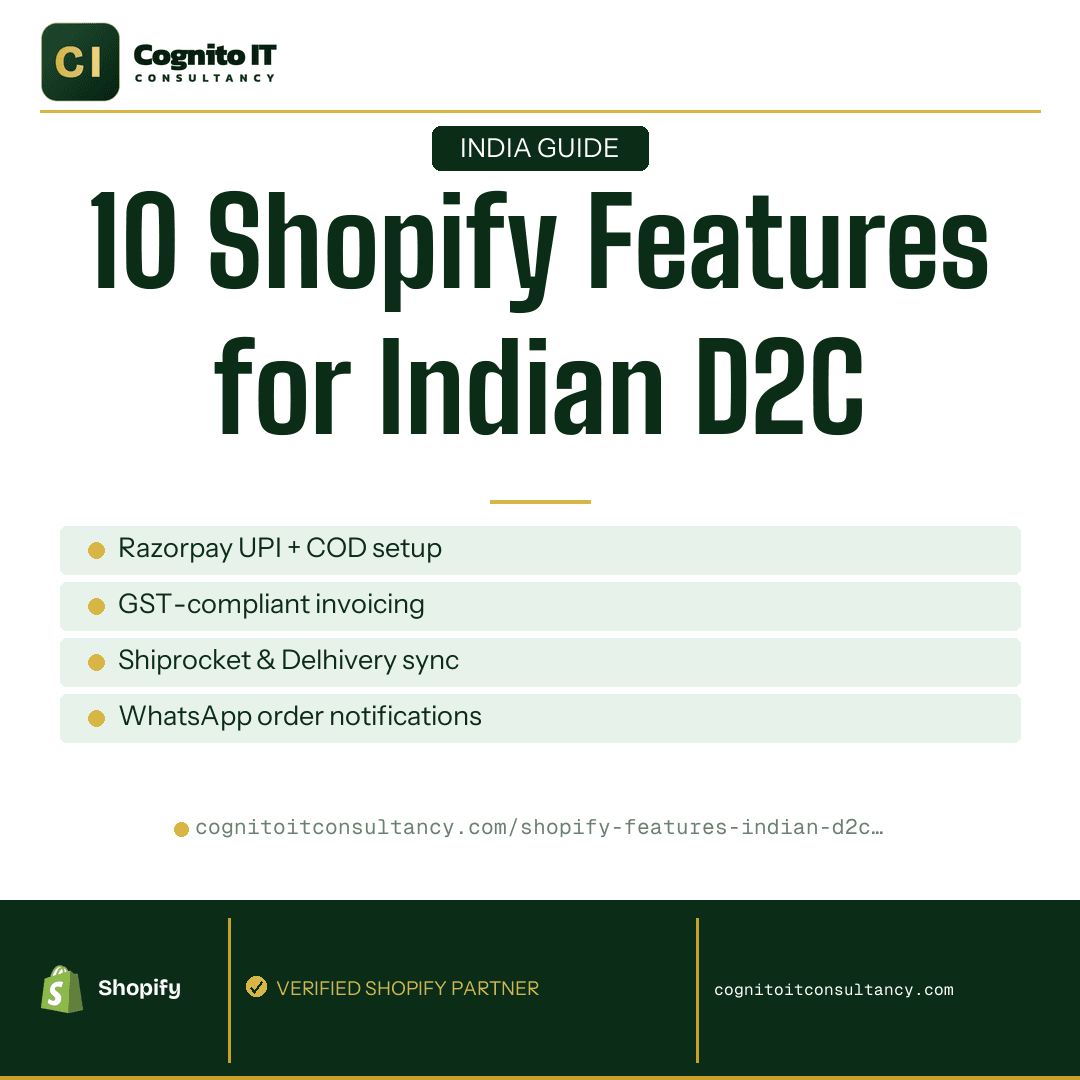
10 Shopify Features Every Indian D2C Brand Must Use in 2026
Last month, a Pune-based jewellery brand came to us after losing ₹3.2 lakh in a single quarter. Not to fraud. Not to bad products. They lost it because their Shopify store wasn’t configured for how Indians actually shop online. No COD option. No UPI. Cart abandonment emails going to spam. The basics were broken.
Here’s what I’ve learned after setting up Shopify features for Indian D2C brands across 100+ stores: the platform is genuinely powerful, but it’s built with American shopping habits in mind. Your job is to rewire it for a customer in Indore who wants to pay via PhonePe, needs a GST invoice for their business purchase, and will absolutely cancel if they don’t get a WhatsApp order confirmation.
These ten features aren’t optional extras. They’re the difference between a store that converts at 1.2% and one that hits 3.5%.
1. Razorpay Integration: UPI, Cards, Net Banking, and Wallets in One Place
If you’re still running Shopify Payments alone, you’re leaving money on the table. Literally. Shopify Payments doesn’t support UPI natively, and UPI now accounts for over 75% of digital transactions in India.
Razorpay fixes this. One integration gives you UPI (including UPI intent for mobile), all major debit and credit cards, net banking for 50+ banks, and wallets like Paytm and Freecharge. The checkout feels seamless because customers stay on your site. No jarring redirects to a payment page that looks like it was designed in 2009.
The setup takes about 20 minutes if you know what you’re doing. We’ve written a complete Razorpay on Shopify India guide that walks through the API keys, webhook configuration, and the one setting most people miss (automatic capture vs manual). Get this wrong and you’ll wonder why payments aren’t completing.
One thing we always tell clients: enable Razorpay’s “Offers” feature. You can show bank-specific discounts right on the checkout page. “Extra 10% off with HDFC cards” works well. It’s free to set up and we’ve seen it bump conversions by 8-12% during sale periods.
2. Cash on Delivery with Auto-Confirmation SMS
I know, I know. COD feels like a step backward. Higher RTO rates, cash handling headaches, the whole mess. But here’s the reality: for Tier 2 and Tier 3 cities, COD still accounts for 60-65% of orders. If you don’t offer it, you’re not competing with other D2C brands. You’re competing with local retail.
The trick isn’t avoiding COD. It’s making it smarter. Set up automatic SMS confirmation the moment someone places a COD order. Use a service like MSG91 or Gupshup. The message should include order details and a clear “Reply CONFIRM to verify” option.
Why does this work? Because fake COD orders, where someone enters a random address just to see if checkout works, almost never confirm. We’ve seen RTO rates drop by 15-20% just from this one addition.
Also, and this is important: don’t show COD for orders above a certain value. ₹3,000-5,000 is a reasonable threshold for most fashion and beauty brands. High-value COD orders have the worst RTO rates.
3. GST-Compliant Invoice Generation
This sounds boring until you get a bulk order from a business customer and they ask for a proper GST invoice. Then it becomes urgent.
Shopify’s default invoices don’t include your GSTIN, HSN codes, or the tax breakup format that Indian businesses need. You need an app like Invoice Falcon, Sufio, or EasyInvoice. Set it up once, configure your GSTIN and state code, map your products to HSN codes, and every order automatically generates a compliant invoice.
This matters for B2B sales, corporate gifting, and honestly, even for regular customers. A branded, professional invoice makes your store look more legitimate. We had a home decor brand tell us their corporate orders doubled after they started sending proper invoices. Customers were expensing purchases to their companies.
4. Shiprocket or Delhivery Shipping Sync
Manual shipping label creation stops being viable the moment you cross 30-40 orders a day. You need automation.
Shiprocket is the go-to for most Indian D2C brands because it aggregates multiple courier partners: Delhivery, BlueDart, Ekart, XpressBees. It automatically picks the cheapest or fastest option based on the pincode. The Shopify integration pulls orders automatically, generates AWB numbers, and pushes tracking info back to your store.
The setup isn’t complicated, but the configuration matters. Make sure you set weight-based rules correctly. Shiprocket charges by volumetric weight, and I’ve seen brands lose margins because they didn’t account for bulky but light products like cushions or bags.
For premium brands or those shipping fragile items, consider a direct Delhivery integration instead. Better handling, fewer damages, slightly higher cost. Worth it for anything above ₹2,000 AOV.
5. Abandoned Cart Recovery Emails
Here’s a stat that should make you uncomfortable: the average cart abandonment rate in India is 78%. For every 100 people who add something to cart, 78 leave without paying.
Shopify has built-in abandoned cart emails, but they’re basic. One email, generic template, not much customisation. You need a proper sequence.
We typically set up three emails: one at 1 hour (quick reminder, no discount), one at 24 hours (social proof, maybe a review), and one at 72 hours (small incentive, 5-10% off or free shipping). The timing matters. Send too fast and you’re annoying. Too slow and they’ve already bought elsewhere.
Use Klaviyo or Omnisend for this. The free tiers are generous enough for stores under 500 orders/month. Check out our CRO strategies guide for the exact email templates we use.
6. One-Page Checkout to Reduce Drop-Off
Shopify finally rolled out one-page checkout in late 2024, and honestly, it should have happened years ago. The old three-page checkout (information, shipping, payment) lost people at every step.
One-page checkout shows everything on a single screen. Address, shipping options, payment methods, all visible. The customer can see exactly what they’re paying before they commit. We’ve measured a 12-18% improvement in checkout completion rates after switching.
If you’re on Shopify Plus, you’ve had this for a while. If you’re on regular Shopify, make sure you’ve enabled it in Settings > Checkout > Checkout layout. It’s not automatic.
One caveat: one-page checkout works best when you have few shipping options. If you’re showing eight different courier choices with varying prices and delivery times, the page gets overwhelming. Simplify first.
7. Multi-Currency Display for NRI and Export Customers
Even if 90% of your orders are domestic, that 10% from NRIs and international customers often has higher AOV. They’re buying gifts for family, stocking up during India visits, or just willing to pay premium for Indian brands.
Shopify Markets handles this natively now. You can show prices in USD, GBP, AED, SGD, wherever your diaspora lives, while keeping your default in INR. The conversion happens automatically based on live rates, or you can set custom rates with a margin built in.
Make sure your shipping rates make sense for international orders though. Nobody’s paying ₹2,500 shipping on a ₹1,200 kurta. Either build shipping into product prices for international customers or set minimum order values for free international shipping.
8. Product Review Apps: Judge.me or Loox
Social proof isn’t optional anymore. Indian customers check reviews obsessively. We’ve done heatmap studies showing people scroll directly to reviews before even reading product descriptions.
Judge.me is the best value option. Free tier is genuinely useful, paid tier (₹1,200/month roughly) unlocks photo reviews, Q&A, and review request emails. Loox is prettier and better for visual products like fashion or home decor, but costs more.
The real difference comes from automating review requests. Set up an email that goes out 7-10 days after delivery, not after purchase. Ask for photos. Offer a small incentive (10% off next order) for photo reviews. User-generated content is gold for your ads later.
One brand we work with, a Chennai-based skincare company, went from 12 total reviews to over 800 in six months just by automating requests and making it dead simple to leave one.
9. WhatsApp Notification Integration
Email open rates in India hover around 15-18%. WhatsApp message open rates? 95%+. This isn’t even close.
Set up WhatsApp notifications for order confirmation, shipping updates, and delivery completion at minimum. Apps like DelightChat, Interakt, or Wati handle this. They integrate with Shopify and use the official WhatsApp Business API, so your messages actually get delivered reliably.
The ROI calculation is simple: fewer “where is my order” support tickets, lower WISMO complaints, and customers who feel informed. We’ve seen support ticket volume drop by 40% after implementing WhatsApp updates.
One extra thing we do: set up a “reply to reorder” flow. Customer gets delivery confirmation, replies “reorder”, and gets a cart link with the same products. Works brilliantly for consumables like supplements, skincare, and pet food.
10. Return Management Setup
Returns happen. The question is whether you handle them gracefully or make customers feel like they’re fighting for a refund.
Shopify’s native returns system is bare-bones. Use an app like Return Prime, Loop Returns, or AfterShip Returns to create a proper self-service portal. Customer enters order number, selects reason, chooses refund or exchange, gets a prepaid label. Done in 90 seconds.
For Indian stores, we recommend offering “refund to store credit” as the default option, with a 10% bonus. “Get ₹1,100 store credit instead of ₹1,000 refund.” Most customers take it, and you keep the revenue in your ecosystem.
Good store design includes making your return policy visible on product pages, not buried in a footer link nobody clicks.
How to Prioritise: Tier 1 vs Tier 2 Features
You don’t need all ten on day one. Here’s how we sequence implementation for new stores:
Tier 1, set up before you launch:
- Razorpay integration (non-negotiable for payments)
- COD with SMS confirmation (if targeting beyond metros)
- Shiprocket/Delhivery sync (manual shipping doesn’t scale)
- One-page checkout (free, already in Shopify, just enable it)
Tier 2, add within first 3 months:
- Abandoned cart email sequence (starts recovering revenue immediately)
- WhatsApp notifications (reduces support load)
- Product reviews app (needs orders first to generate reviews)
- GST invoicing (important once you have regular B2B orders)
Tier 3, add as you scale:
- Multi-currency for international customers
- Advanced return management portal
What Most Stores Miss: COD Verification and Prepaid Incentives
Two things we set up on every store that almost nobody does on their own:
COD verification beyond SMS: For high-risk pincodes (yes, there are lists), add an IVR verification step. Automated call, customer presses 1 to confirm. Sounds old-school, but it catches the orders that SMS verification misses. Exotel or MyOperator can set this up.
Prepaid incentive discounts: Show a small discount, ₹30-50 or free shipping, for prepaid orders right on the checkout page. Not buried in terms, visible where payment method selection happens. “Pay online and save ₹50” converts more people to prepaid than any other tactic we’ve tested. Lower RTO, faster cash flow, happier logistics team.
If you’re doing custom integrations, our Shopify API integration guide covers how to build these conditional discount flows programmatically.
How We Configure These on Every India Project
When a new client comes to Cognito IT, we don’t ask “which features do you want?” We run through a checklist:
- Payment audit: What’s enabled, what’s missing, what’s broken
- Shipping configuration: Weight rules, zone pricing, courier selection logic
- Checkout flow analysis: Where are people dropping off?
- Communication setup: What happens after someone orders? Do they hear from you?
- Return policy review: Is it clear, fair, and automated?
Usually takes us about a week to fully configure a store. Sometimes less if the brand has already done some work. Sometimes longer if we’re migrating from WooCommerce or custom platforms with years of accumulated weirdness.
The goal isn’t to add features for the sake of it. The goal is to remove every reason a customer might have to abandon, complain, or not come back. That’s what these ten features do when they’re configured properly.
Want us to set this up on your store? Book a free Shopify audit →