



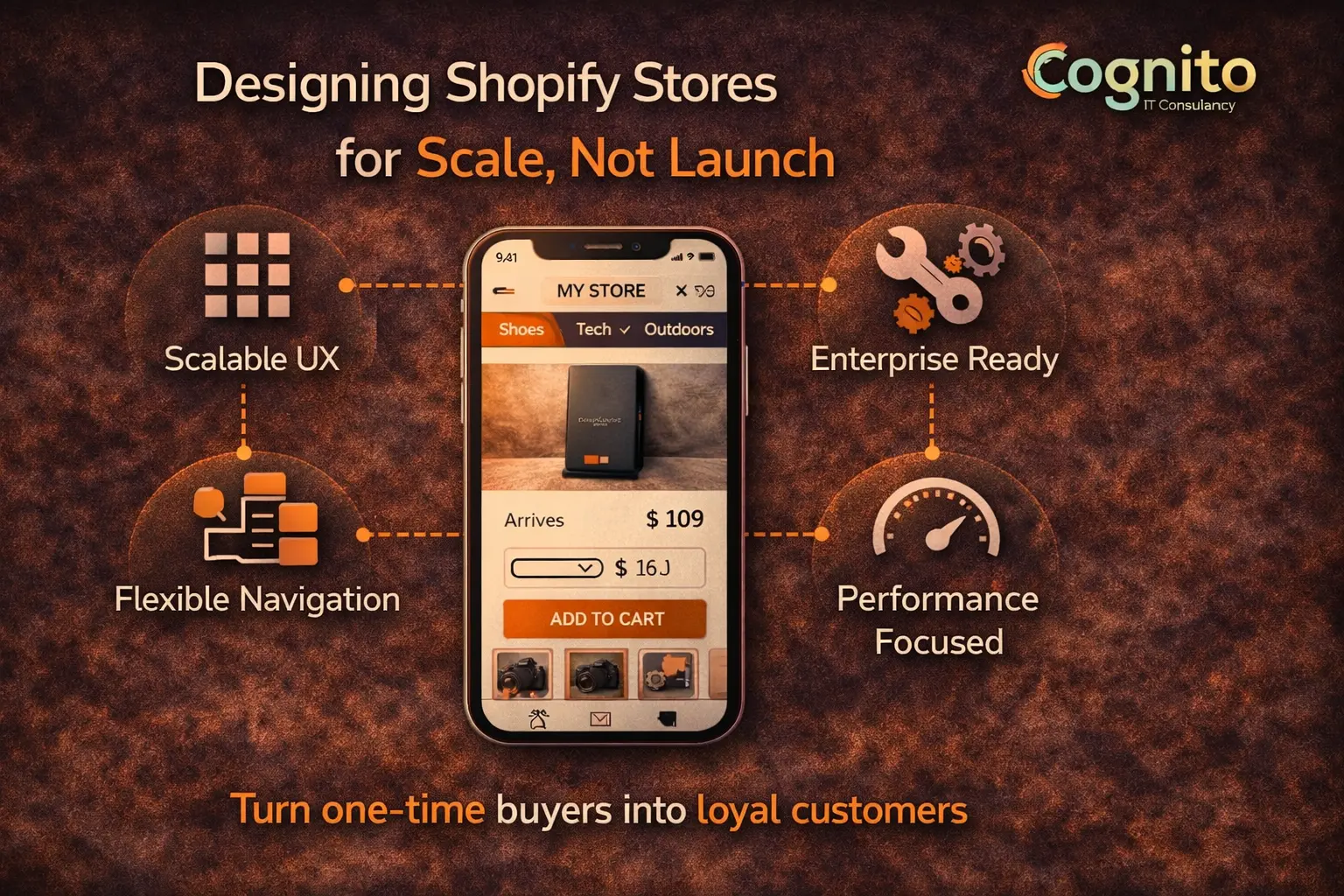
Designing Shopify stores for scale requires a very different mindset than designing for launch. Yet most stores are built with short-term goals in mind.
They look good on day one.
They convert early traffic.
Then they break as growth accelerates.
Enterprise-ready Shopify stores are not accidental. They are designed to handle complexity, traffic, and evolving customer expectations from the start.
Why Designing Shopify Stores for Scale Matters
Launching fast feels good. Scaling exposes weaknesses.
When stores are not designed for scale:
- UX becomes cluttered
- Navigation breaks under large catalogs
- Performance degrades
- Conversion rates plateau
As a result, brands face expensive redesigns just when momentum matters most.
Launch UX vs Scale UX: The Critical Difference
Launch-focused UX prioritizes speed and simplicity.
Scale-focused UX prioritizes:
- Flexibility
- Clarity under complexity
- Consistent performance
- Long-term maintainability
Designing Shopify stores for scale means planning for what your store will become—not just what it is today.
UX Decisions That Break at Scale
Many early UX decisions seem harmless. Over time, they become bottlenecks.
Common examples include:
- Flat navigation that cannot grow
- Homepage layouts optimized for one product category
- Filters that do not scale with inventory size
- Mobile UX that fails under feature-heavy pages
Eventually, these choices limit growth.
Navigation Design That Fails as Catalogs Grow
Navigation works differently at scale.
Problems often include:
- Too many menu items
- Poor category hierarchy
- No support for faceted browsing
When users cannot find products quickly, engagement drops.
Scalable navigation is foundational to designing Shopify stores for scale.
Homepage UX That Locks Brands Into Early Assumptions
Early-stage homepages often assume:
- A narrow audience
- Few products
- One primary use case
At scale, those assumptions collapse.
A scalable homepage:
- Supports multiple segments
- Adapts to promotions and campaigns
- Evolves without full redesigns
Mobile UX Is the First Point of Failure at Scale
Mobile traffic dominates at scale.
However, many stores suffer from:
- Overloaded product pages
- Heavy scripts slowing interaction
- Poor touch targets
Because of this, mobile conversion rates decline first.
Designing mobile-first is non-negotiable for scalable Shopify stores.
Performance UX: When Design Slows Revenue
Performance is part of UX.
Design decisions that hurt performance include:
- Heavy animations
- Excessive JavaScript
- Overloaded templates
At scale, even small delays cost revenue.
Designing Shopify stores for scale means treating performance as a UX requirement.
Checkout UX That Breaks Under Volume
Checkout issues grow with traffic.
Common scale problems:
- Too many conditional fields
- Inflexible layouts
- Poor error handling
When checkout UX is not designed for scale, abandonment increases precisely when demand peaks.
Why Enterprise Readiness Requires UX + Engineering Alignment
UX alone cannot scale Shopify.
Enterprise readiness requires:
- UX designed with technical constraints in mind
- Engineering support for flexibility and performance
- Clean, modular implementations
Without alignment, design decisions create technical debt.
How Cognito Designs Shopify Stores for Scale
At Cognito, we design Shopify stores with growth already in mind.
Our approach includes:
- Scale-first UX frameworks
- Flexible navigation and layout systems
- Performance-aware design decisions
- Engineering-backed implementation
- Ongoing optimization as complexity grows
This ensures Shopify stores remain fast, usable, and conversion-focused as they scale.
FAQs: Designing Shopify Stores for Scale
What does designing for scale mean in Shopify?
It means building UX that adapts to growth, complexity, and traffic without breaking.
Why do Shopify stores fail after early growth?
Early UX decisions do not support larger catalogs, traffic, or user segments.
Is Shopify suitable for enterprise scale?
Yes—when UX and architecture are designed for scale from the start.
When should brands redesign for scale?
Before growth exposes weaknesses, not after revenue is at risk.
Does scale-focused UX improve conversions?
Yes. Clear, flexible UX sustains conversions as complexity increases.
Conclusion
Designing Shopify stores for scale is about thinking beyond launch-day success.
Brands that plan for scale avoid costly rebuilds, protect conversion rates, and stay agile as growth accelerates.
If your store was designed only to launch, it may not be ready to scale.
→ Get a Personalized Recommendation from Cognito.
📩 Get your free audit here: https://cognitoitconsultancy.com/
📧 Book a Strategy Call: sandy@cognitoitconsultancy.com
👉 Meet Now: https://cal.com/cognitoitconsultancy/30min
🔗 Shopify Experts: Click Here
Follow Us for More Insights on D2C and Digital Transformation
Stay ahead of the curve in e-commerce, digital strategy, and IT consulting by connecting with us on our social platforms: