


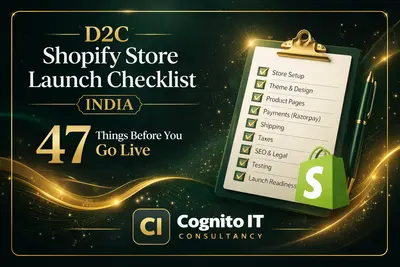
D2C Shopify Store Launch Checklist India (2026) — 47 Things Before You Go Live
The only launch checklist built specifically for Indian D2C brands — covering Razorpay, UPI, COD, Shiprocket, GST compliance, GA4, and every critical step before your first sale.
A Shopify launch checklist is a step-by-step list of tasks you must complete before going live to ensure your store is ready for payments, shipping, tracking, and conversions. In India, missing even one step — like COD verification or Razorpay integration — can mean failed payments, high RTO returns, or lost revenue from Day 1. This 47-point checklist covers every critical task for Indian D2C brands.
Launching a Shopify store in India without a structured checklist is like opening a physical store without testing the payment machine. Everything looks ready — until a real customer arrives.
We've onboarded 40+ D2C brands at Cognito IT Consultancy and the pattern is consistent: brands that launch with this checklist complete hit their first ₹5 lakhs faster, with fewer refunds, lower RTO rates, and cleaner data from Day 1. The ones that skip steps spend Week 1 firefighting instead of selling.
- Connect custom domain — Avoid .myshopify.com in your URL. A branded domain adds trust and improves SEO from Day 1.Critical
- Enable SSL (https) — Shopify provides free SSL. Verify the padlock appears on all pages before any transaction.Critical
- Choose a fast Shopify theme — Dawn (free) is the fastest Shopify theme available. Mobile-first, Core Web Vitals optimised, conversion-ready.High
- Optimise homepage — USP above the fold, trust signals (secure badge, COD available, free returns), social proof, and a clear CTA.High
- Set up navigation — Collections, categories, search bar. Indian customers browse by category before searching by product name.High
- Add About Us page — Real founder photo, brand story, and origin. Indian customers research the brand before buying from an unknown seller.Medium
- Add Contact page — Phone number AND email visible. WhatsApp number preferred. Brands with visible contact info see 12–18% higher conversion.High
- Integrate Razorpay — The most reliable payment gateway for Indian Shopify stores. Supports UPI, cards, netbanking, EMI, and BNPL out of the box.Critical
- Enable UPI payments — UPI is now the #1 payment method in India. Brands that added UPI saw 22% uplift in checkout completion immediately.Critical
- Enable cards + net banking — Credit card EMI is essential for products above ₹1,500. Enable no-cost EMI via Razorpay for higher AOV.High
- Enable COD (Cash on Delivery) — COD is 40–60% of all Indian D2C orders. Not enabling COD means losing more than half your potential customers from Day 1.Critical
- Add COD verification (OTP / IVR) — Unverified COD leads to 20–35% fake orders and high RTO rates. OTP verification reduces this by 30–50%.Critical
- Add prepaid discount (₹50–₹100) — Incentivise digital payment. Brands that added a prepaid discount shifted 15–25% of COD orders to prepaid within 3 months.High
- Integrate Shiprocket / NimbusPost / Delhivery — Multi-carrier logistics aggregators covering 29,000+ pin codes. Never rely on a single carrier in India.Critical
- Configure shipping zones (India-wide) — Set up Tier 1, Tier 2, and Tier 3 zones. Different carriers perform differently across zones — your logistics partner handles routing.Critical
- Set shipping rates (free / flat / dynamic) — Free shipping above ₹499 or ₹999 is the most common Indian D2C trigger. Test what works for your AOV and margins.High
- Configure COD shipping rules — Charge ₹40–₹60 for COD to offset reverse logistics costs. This also deters low-intent buyers without hurting genuine demand.High
- Display delivery timelines on product pages — "Delivered by [date]" on product pages reduces checkout abandonment significantly. Shiprocket provides pin-code-based ETA widgets.High
- Enable order tracking for customers — Branded tracking page via Aftership or Shiprocket. Reduces "Where is my order?" support tickets by 40–60%.Medium
- Install Google Analytics 4 (GA4) — Set up GA4 with Shopify's native Google channel. Configure purchase events, funnel steps, and channel groupings from Day 1.Critical
- Install Meta Pixel — Required for Facebook and Instagram ad retargeting. Install via Shopify's Meta channel app, not manually, to avoid duplication errors.Critical
- Connect Google Search Console — Verify your domain, submit sitemap, and monitor index coverage from Day 1. Google needs time to crawl — start early.High
- Submit XML sitemap — Shopify auto-generates /sitemap.xml. Submit this URL in Google Search Console immediately after launch.High
- Configure robots.txt — Shopify's default robots.txt is fine for most stores. If you have staging pages or admin-facing collections, block them explicitly.Medium
- Optimise meta titles & descriptions — Every product page, collection, and homepage needs a unique meta title with target keyword + India modifier (e.g., "buy online India").High
- Add alt text to all images — Descriptive alt text improves Google Image Search traffic and accessibility. Format: "[Product name] — [key attribute] — [brand]".High
- Optimise product pages — 5+ product images, benefits-first copy (not features-first), size guide, FAQs, delivery estimate, and a sticky Add-to-Cart button on mobile.Critical
- Add trust badges — Secure checkout badge, COD available, easy returns, 100% original guarantee. Place these near the Add-to-Cart button — not just in the footer.High
- Enable reviews & ratings — Judge.me or Loox. Photo reviews are 3× more persuasive than text reviews for Indian D2C buyers. Import existing reviews if migrating.High
- Add urgency elements — "Only 8 left", limited-time offer countdown, "12 people viewing this". Use authentically — fake scarcity erodes trust with Indian buyers.Medium
- Optimise checkout UX — Enable one-page checkout, reduce form fields, allow guest checkout. Every extra field in checkout reduces completion by 5–10%.High
- Enable WhatsApp chat widget — Interakt or AiSensy. Indian customers prefer WhatsApp over email for pre-purchase questions. Reduces bounce from the product page.High
- Add GST details to store — Display your GSTIN in the footer and on invoices. Required for B2B orders and adds instant trust to your brand. Install TaxHero for GST-compliant invoices.Critical
- Create Privacy Policy page — Required by Indian IT rules and Meta's ad policies. Use Shopify's generator as a starting point, then customise for India-specific data handling.Critical
- Create Terms & Conditions page — Covers product quality disclaimers, dispute resolution, and jurisdiction (India). Without T&C, you have no legal recourse in disputes.High
- Add Refund & Return Policy — Indian consumers expect clear return windows. 7-day or 15-day returns are standard. Make it easy to find — link from every product page footer.Critical
- Add Shipping Policy — State delivery timelines by zone, COD availability, and what happens if delivery fails. Reduces "Where is my order?" support tickets.High
- Place test order — prepaid — Use Razorpay's test mode. Verify the full flow: product → cart → checkout → payment success → confirmation email.Critical
- Place test order — COD — Verify COD selection works, OTP fires, order confirmation arrives by SMS and email, and Shiprocket receives the order.Critical
- Verify payment success / failure flow — Test both success and deliberate payment failure. The failure redirect must not lose the customer's cart.Critical
- Test mobile checkout experience — Open your store on an actual Android phone (not emulator). 78% of Indian traffic is mobile — the checkout must be flawless on a 390px screen.Critical
- Verify shipping rate calculations — Add products to cart and check that shipping rates calculate correctly for Tier 1, Tier 2, and Tier 3 pin codes.High
- Check email & SMS notifications — Verify order confirmation, shipping, and delivery notifications reach the customer. Check spam folders for email deliverability.High
- Test website speed — Run Google PageSpeed Insights on your homepage and top product page. Target 70+ on mobile. Compress images if score is below 60.High
- Set up abandoned cart recovery — Configure Klaviyo or Shopify's native flow: first email at 1 hour, second at 24 hours. Indian D2C brands recover 10–15% of abandoned carts.High
- Configure WhatsApp order automation — Set up order confirmation + shipping update via Interakt or AiSensy. WhatsApp has 60–70% open rates vs 20–25% for email in India.High
- Review all pages on mobile before going live — Navigation, product pages, checkout, about us, legal pages. Ask a friend to try buying something without any guidance from you.Critical
🚨 Common Shopify Launch Mistakes in India
Launching Without Testing Payments
The most common — and most painful — mistake. Payment failures on Day 1 mean refund requests, negative reviews, and a broken first impression that's hard to recover from.
Ignoring Mobile Optimisation
Launching a desktop-first store in India is like opening a shop with no entrance. 78% of your traffic will be on mobile — if the experience is broken there, you don't have a store.
Not Enabling COD Verification
Unverified COD is an open door for fake orders. Without OTP verification, 20–35% of COD orders in high-risk pin codes will be returned — you pay shipping both ways.
Missing Tracking Setup
Launching without GA4 and Meta Pixel means you're flying blind. You won't know which ads work, which pages leak customers, or what your actual conversion rate is.
Poor Shipping Configuration
Incorrect shipping rates at checkout — especially showing ₹0 shipping when you're actually paying ₹80 — destroys margins silently. Delivery to unserviceable pin codes creates failed orders and refund requests.
📊 Shopify D2C Benchmarks India (2026)
Use these numbers to set realistic launch targets and identify where your store needs improvement:
Industry average for D2C
Varies by category & Tier
Category-dependent
With Klaviyo + WhatsApp
Mobile product page
With proper setup
If your store converts at 1% and the benchmark is 1.5–3%, a CRO audit will typically find 3–5 fixable issues — checkout friction, missing trust signals, or poor mobile UX. A 0.5% improvement at 1,000 monthly visitors = 5 extra sales/month. At ₹1,500 AOV, that's ₹7,500/month recovered without spending more on ads.
Download the Full 47-Point Shopify Launch Checklist PDF
Print it, tick it off, and go live with confidence. The exact checklist our team uses with every D2C client in India — including priority order and pro tips for each item.
No spam. Unsubscribe anytime.
🔗 Related Services from Cognito IT Consultancy — Verified Shopify Partner, Bangalore
❓ FAQs — Shopify Launch Checklist India
Before launching, check: payment gateway (Razorpay + UPI + COD with verification), shipping setup (Shiprocket / NimbusPost with India-wide zones), tracking (GA4 + Meta Pixel), mobile experience, legal pages (Privacy Policy, Return Policy, GST details), and place successful test orders both prepaid and COD. Missing any of these can cost you revenue from Day 1.
Razorpay is the best payment gateway for Shopify India in 2026. It supports UPI, credit and debit cards, net banking, EMI, and BNPL. It integrates natively with Shopify and provides a GST-compliant reconciliation dashboard. Cashfree is a strong alternative with competitive per-transaction fees at high volume.
Launching a Shopify store in India properly takes 2–3 weeks: 1 week for store setup and design, 1 week for payment, shipping, and legal setup, and 1 week for testing and pre-launch optimisation. Rushing to launch in 3 days without completing this checklist typically results in the first week spent fixing broken flows instead of making sales.
Not testing the checkout and payment flow. Founders often discover payment failures, broken COD flows, or incorrect shipping calculations only after real customers start ordering — resulting in lost revenue, refund requests, and negative first impressions that are very hard to recover from in a market where trust is everything.
Absolutely. COD accounts for 40–60% of all Indian D2C orders depending on the category and tier. Not enabling COD means losing more than half your potential customers on Day 1. Always pair COD with OTP verification to reduce fake orders and RTO (Return to Origin) rates, which can otherwise reach 20–35% in unverified COD flows.
A good conversion rate for Indian Shopify D2C stores is 1.5%–3%. The benchmark for cart abandonment recovery is 10–15% with Klaviyo plus WhatsApp flows. Average order values typically range from ₹800 to ₹2,000. If you're below 1.5%, a CRO audit almost always finds 3–5 high-impact fixes on the product page or checkout flow.
Yes, if your annual turnover exceeds ₹40 lakhs (₹20 lakhs for special category states). GST registration is also required to issue proper invoices to B2B customers and is expected by most Indian payment gateways. Even below the threshold, displaying your GSTIN adds significant trust, especially for first-time buyers.
🚀 Need Help Launching Your Shopify Store?
We've helped 40+ Indian D2C brands launch high-converting Shopify stores — from store architecture to payment setup to Day 1 SEO.
- Launch high-converting Shopify stores
- Optimise checkout & payments
- Reduce COD returns (RTO)
- Set up SEO, CRO & automation from Day 1