



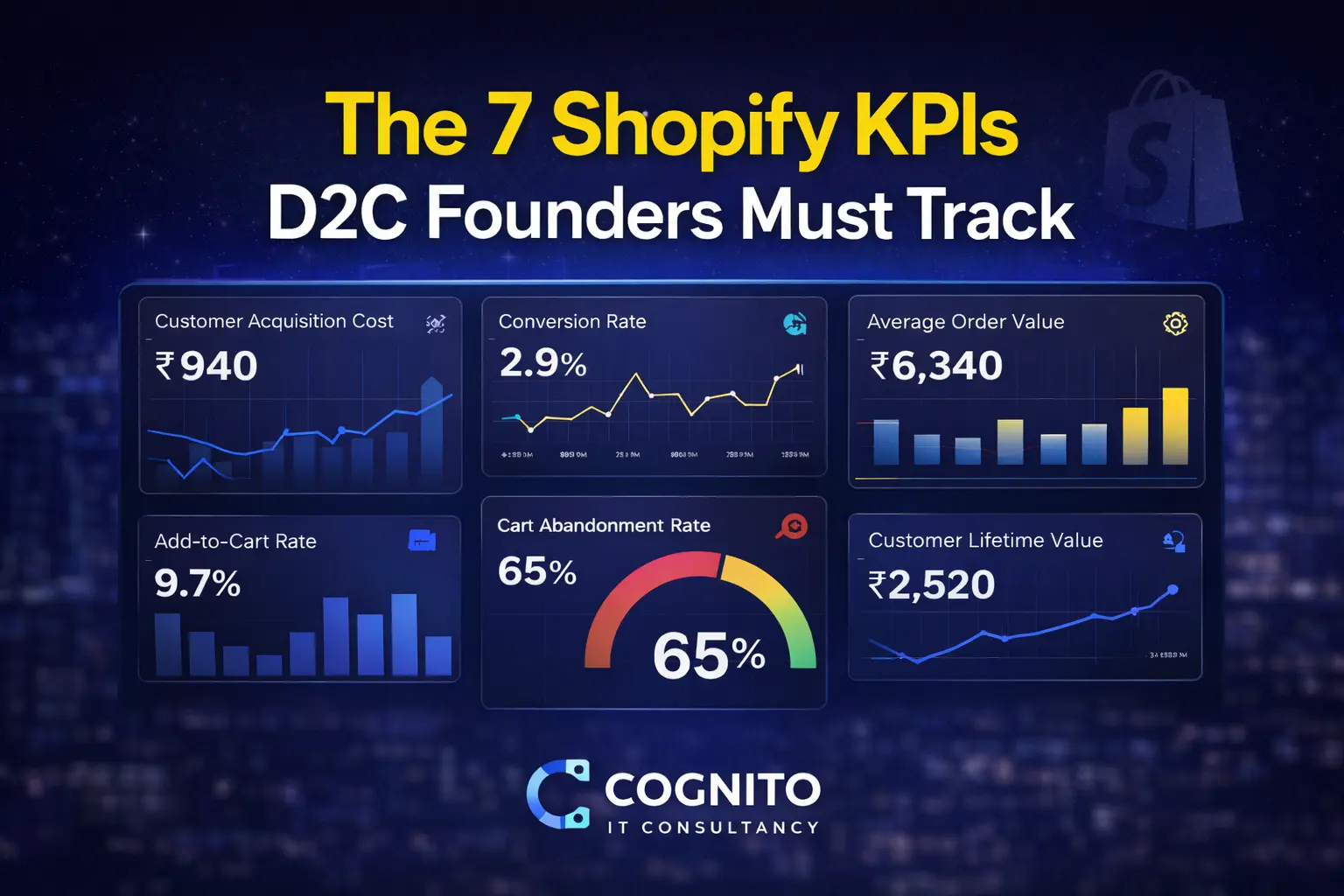
Running a Shopify store is easier than ever. However, scaling one profitably is much harder. Many founders focus on revenue. They check daily sales, ad spend, and order numbers. Yet those numbers alone rarely reveal the real story behind growth. The brands that scale consistently track a different set of numbers. They track the Shopify KPIs D2C founders must understand to diagnose performance, identify growth opportunities, and fix hidden conversion leaks.
Without these metrics, scaling becomes guesswork.
With them, your store becomes a predictable growth engine.
In this guide, we’ll break down the 7 Shopify KPIs D2C founders must track and explain what “good” actually looks like.
Why Shopify KPIs D2C Founders Track Matter
Revenue alone cannot explain whether a business is healthy.
For example, two stores might both generate ₹20 lakh per month. Yet one might be highly profitable, while the other quietly loses money due to inefficient marketing and poor conversion rates.
This difference happens because successful brands focus on performance indicators, not just revenue.
Tracking the right Shopify KPIs D2C brands rely on helps founders answer critical questions:
- Are visitors converting into customers?
- Is marketing spend sustainable?
- Are customers coming back to buy again?
- Is the store infrastructure optimised for growth?
When founders track these metrics consistently, decision-making improves dramatically.
Shopify KPIs D2C Founders Must Track for Store Performance
Conversion Rate
Conversion rate measures the percentage of visitors who complete a purchase.
It is one of the most important Shopify KPIs D2C founders track because it reveals how effectively a store converts traffic into revenue.
What a Good Conversion Rate Looks Like
- Below 1% → Major UX or traffic issues
- 1–2% → Average performance
- 2–3% → Healthy store performance
- 3%+ → High-performing Shopify store
Why Conversion Rate Matters
Improving conversion rate increases revenue without increasing traffic.
For example:
If your store receives 10,000 visitors per month:
- 1% conversion = 100 orders
- 2% conversion = 200 orders
That means revenue doubles without spending more on ads.
Shopify KPIs D2C Founders Must Track for Marketing Efficiency
Customer Acquisition Cost (CAC)
Customer acquisition cost measures how much you spend to acquire one new customer.
CAC Formula
Marketing spend ÷ number of new customers
CAC is critical because it determines whether your marketing strategy is profitable.
Healthy CAC Benchmark
For most Shopify stores:
CAC should be less than 30–35% of average order value.
If acquisition costs rise above this threshold, scaling becomes difficult.
Why CAC Matters
Many founders scale ads aggressively without monitoring CAC. As a result, marketing costs rise faster than revenue.
Tracking CAC prevents this mistake.
Shopify KPIs D2C Founders Must Track for Revenue Growth
Average Order Value (AOV)
Average order value measures how much customers spend per order.
AOV Formula
Total revenue ÷ total number of orders
Increasing AOV allows brands to spend more on customer acquisition while maintaining profitability.
How to Improve AOV
Common strategies include:
- Product bundles
- Checkout upsells
- Cross-sell recommendations
- Free shipping thresholds
Even small improvements in AOV can significantly increase revenue.
Shopify KPIs D2C Founders Must Track for Long-Term Profitability
Customer Lifetime Value (LTV)
Customer lifetime value represents the total revenue generated by one customer over their relationship with your brand.
This metric is essential for D2C businesses because retention drives sustainable growth.
Healthy LTV Benchmark
Successful Shopify brands aim for an LTV to CAC ratio of 3:1 or higher.
If CAC and LTV are equal, marketing profitability disappears.
Why LTV Matters
Retention costs far less than acquisition. Therefore, increasing LTV dramatically improves business stability.
Brands increase LTV through:
- Email marketing
- Loyalty programs
- Subscription models
- Personalized offers

Shopify KPIs D2C Founders Must Track for Product Page Performance
Add-to-Cart Rate
Add-to-cart rate measures how many visitors add products to their cart.
This KPI reveals how compelling your product pages are.
Add-to-Cart Rate Benchmarks
- Below 5% → Weak product pages
- 5–8% → Average engagement
- 8–10% → Strong product performance
How to Improve the Add-to-Cart Rate
Common improvements include:
- Better product images
- Strong value propositions
- Customer reviews
- Trust badges
Optimising product pages often increases the add-to-cart rate quickly.
Shopify KPIs D2C Founders Must Track for Checkout Optimisation
Cart Abandonment Rate
Cart abandonment measures how many shoppers add items to their cart but do not complete checkout.
Typical Cart Abandonment Range
Most Shopify stores see abandonment rates between 60% and 80%.
Although some abandonment is normal, very high rates indicate checkout friction.
Common Causes
- Unexpected shipping costs
- Slow checkout pages
- Too many form fields
- Limited payment options
Reducing friction in checkout can significantly increase revenue.
Shopify KPIs D2C Founders Must Track for Customer Loyalty
Returning Customer Rate
The returning customer rate shows how many buyers purchase again.
This metric reflects brand loyalty and customer satisfaction.
Returning Customer Benchmarks
Healthy Shopify stores typically see:
- 20–30% returning customers
Higher retention often indicates a strong customer experience.
How to Improve Retention
Effective retention strategies include:
- Email marketing campaigns
- Loyalty programs
- Personalised product recommendations
- Post-purchase engagement
Retention reduces dependence on paid advertising.
What Good Shopify KPIs Actually Look Like
Below is a simple benchmark table for the Shopify KPIs D2C founders must track.
| KPI | Healthy Benchmark |
|---|---|
| Conversion Rate | 2–3% |
| Customer Acquisition Cost | <30–35% of AOV |
| Average Order Value | Increasing month to month |
| Customer Lifetime Value | 3× CAC |
| Add-to-Cart Rate | 8–10% |
| Cart Abandonment | 60–70% |
| Returning Customers | 20–30% |
These benchmarks vary across industries. However, they provide a useful starting point.
Why Many D2C Founders Struggle With Shopify KPIs
Most founders understand these metrics in theory. Yet implementing them effectively requires infrastructure.
Common challenges include:
- Fragmented analytics tools
- Lack of performance benchmarks
- Limited CRO testing processes
Without structured optimisation systems, founders often react to problems rather than prevent them.
How Cognito IT Helps Optimise Shopify KPIs
At Cognito IT Consultancy, we help Shopify brands transform data into growth.
Our team focuses on three core areas:
Shopify Performance Audits
We identify hidden conversion leaks in speed, UX, and technical infrastructure.
Conversion Rate Optimisation
We redesign critical pages to increase conversion rate and average order value.
Shopify Growth Automation
We implement retention systems that increase lifetime value and customer loyalty.
The result is a Shopify store that performs like a predictable revenue engine.
Final Thoughts
The difference between struggling stores and scaling brands rarely lies in the product.
It lies in the metrics founders track.
Understanding the Shopify KPIs D2C founders must track allows businesses to identify growth opportunities and eliminate revenue leaks.
When these indicators improve, revenue follows naturally.
For founders serious about scaling their Shopify store, tracking these KPIs is not optional. It is essential.
Book a Free D2C Growth Strategy Call
If your brand feels stuck around ₹1 crore, do not increase ad spend blindly.
Instead, strengthen your foundation.
Book a Free D2C Growth Strategy Call
👉 Book a Free D2C Growth Strategy Call: https://cognitoitconsultancy.com/
📧 Book a Strategy Call: info@cognitoitconsultancy.com
👉 Meet Now: https://cal.com/cognitoitconsultancy/30min
🔗 Shopify Experts: Click Here
Follow Us for More Insights on D2C and Digital Transformation
Stay ahead of the curve in e-commerce, digital strategy, and IT consulting by connecting with us on our social platforms:


Let’s build a system that supports serious D2C brand scaling.