

The Modern Shopify Tech Stack: What Growing Brands Get Wrong
The modern Shopify tech stack is supposed to support growth. However, for many scaling brands, it becomes the biggest obstacle to performance, conversions, and stability.
As stores grow, apps accumulate, architecture weakens, and systems fail to work together. As a result, brands experience slower sites, higher costs, and stalled growth.
This article breaks down where growing brands go wrong—and how a strategic tech stack audit fixes it.
What Is the Modern Shopify Tech Stack?
The modern Shopify tech stack includes every layer that powers your store:
- Shopify core platform
- Apps and integrations
- Front-end theme or headless storefront
- Analytics and tracking tools
- Automation and backend systems
When aligned correctly, this stack scales smoothly. When misaligned, performance and revenue suffer.
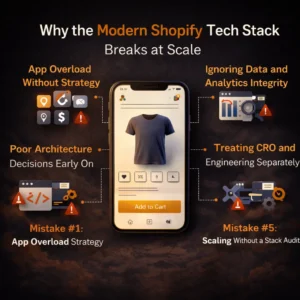
Why the Modern Shopify Tech Stack Breaks at Scale
Most brands build their stack reactively. They add apps to solve short-term problems.
Over time, this creates:
- Overlapping functionality
- Conflicting scripts
- Fragile dependencies
Consequently, the tech stack becomes expensive and unreliable.
Mistake #1: App Overload Without Strategy
Apps feel like quick wins. Yet too many apps slow sites down.
Common issues include:
- Multiple apps doing the same job
- JavaScript bloat on every page
- Monthly costs adding up
Because of this, page speed drops and conversions decline.
Mistake #2: Poor Architecture Decisions Early On
Early technical decisions often stick forever.
For example:
- Hard-coded theme customizations
- No separation between logic and presentation
- Lack of scalable data structures
Eventually, these choices limit flexibility and increase maintenance costs.
Mistake #3: Ignoring Data and Analytics Integrity
A modern Shopify tech stack depends on clean data.
However, many stores suffer from:
- Broken GA4 tracking
- Duplicate events
- Inaccurate conversion data
As a result, teams optimize based on misleading insights.
Mistake #4: Treating CRO and Engineering Separately
Conversion optimization is not just a design problem.
Without engineering alignment:
- Tests take too long
- Performance degrades
- Changes introduce bugs
Therefore, CRO stalls despite good ideas.
Mistake #5: Scaling Without a Stack Audit
Growth exposes weaknesses. Unfortunately, most brands skip audits.
Without a stack review:
- Legacy code remains
- Security risks grow
- Costs spiral
A proactive audit prevents expensive rebuilds later.
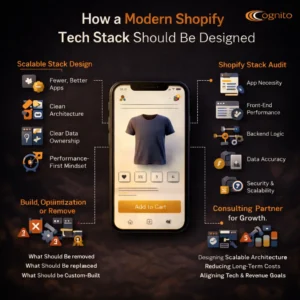
How a Modern Shopify Tech Stack Should Be Designed
A scalable stack focuses on clarity and performance.
Key principles include:
- Fewer, better apps
- Clean architecture
- Clear data ownership
- Performance-first mindset
When these align, growth becomes predictable.
The Role of a Shopify Stack Audit
A professional audit evaluates:
- App necessity and overlap
- Front-end performance
- Backend logic and automation
- Data accuracy
- Security and scalability
This process identifies quick wins and long-term fixes.
Stack Optimization: Build, Replace, or Remove
Not everything needs rebuilding.
A strong audit answers:
- What should be removed
- What should be replaced
- What should be custom-built
This ensures the modern Shopify tech stack supports real business goals.
Why Growing Brands Need a Consulting Partner
At scale, Shopify becomes a system—not just a store.
Consulting partners help by:
- Designing scalable architecture
- Reducing long-term costs
- Aligning tech with revenue goals
This approach turns Shopify into a growth engine.
FAQs: Modern Shopify Tech Stack
What is a modern Shopify tech stack?
It includes Shopify, apps, integrations, analytics, and automation working together.
Why do Shopify stores slow down over time?
App overload and poor architecture are the main causes.
Is a headless Shopify always required?
No. It depends on scale, complexity, and performance needs.
How often should a stack audit be done?
At least once a year or after major growth phases.
Can stack optimization improve conversions?
Yes. Faster, cleaner stacks convert better.
Conclusion
The modern Shopify tech stack should evolve with your business. Yet many growing brands unknowingly sabotage growth with bloated apps and weak architecture.
By auditing, simplifying, and optimizing the stack, brands unlock speed, stability, and scalability.
Growth should not break your store. With the right strategy, it strengthens it.
→ Get a Personalized Recommendation from Cognito.
📩 Get your free audit here: https://cognitoitconsultancy.com/
📧 Book a Strategy Call: sandy@cognitoitconsultancy.com
👉 Meet Now: https://cal.com/cognitoitconsultancy/30min
🔗 Shopify Experts: Click Here
Follow Us for More Insights on D2C and Digital Transformation
Stay ahead of the curve in e-commerce, digital strategy, and IT consulting by connecting with us on our social platforms:


