
Conversion Cost of App Overload Explained
Most Shopify stores don’t fail because of bad products. They fail because of slow experiences. The Conversion Cost of App Overload is one of the most overlooked growth killers in eCommerce. It doesn’t show up in accounting reports. It doesn’t trigger alerts. Yet it quietly erodes revenue every day.
At Cognito IT Consultancy, we frequently observe this pattern. Brands install apps to improve marketing, upselling, reviews, personalization, and analytics. Each app solves one problem.
However, together they create friction.
And friction kills conversions.
What Is the Conversion Cost of App Overload?
The Conversion Cost of App Overload refers to lost revenue caused by excessive third-party apps slowing performance and degrading user experience.
It is not technical debt.
It is conversion decay.
Here’s what happens:
- Multiple scripts load at once
- APIs compete for execution
- Tracking pixels fire simultaneously
- Checkout becomes heavier
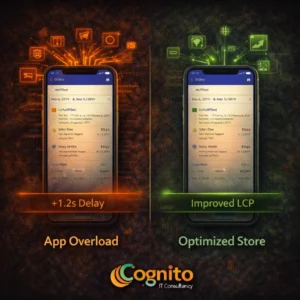
As a result, pages slow down.
And when pages slow down, users leave.
Why the Conversion Cost of App Overload Hurts Performance
Speed drives revenue.
A one-second delay can reduce conversion rates significantly. Now imagine stacking 12–20 apps, each injecting scripts and API calls.
Performance declines in three ways:
1️⃣ Script Bloat
Every installed app adds JavaScript. Even if you disable certain features, many scripts still load.
Consequently, your site becomes heavier with every “small improvement.”
2️⃣ API Latency
Apps often rely on external servers. When those servers respond slowly, your site waits.
Even worse, you cannot control those response times.
3️⃣ Competing Load Priorities
Multiple apps try to load early. Therefore, core content sometimes loads after marketing tools.
That frustrates users.
And frustrated users don’t convert.
User Experience and the Conversion Cost of App Overload
Performance issues are only half the story.
The Conversion Cost of App Overload also affects UX clarity.
Consider this:
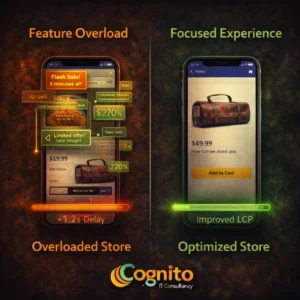
- Popups from different apps overlap
- Upsell widgets compete for attention
- Countdown timers create visual clutter
- Multiple chat bubbles stack in corners
Instead of guiding the customer, the interface overwhelms them.
Too many choices increase hesitation.
Hesitation increases abandonment.
The Hidden Revenue Impact of Conversion Cost of App Overload
Most founders look at traffic and revenue separately.
However, the real damage hides in conversion efficiency.
Let’s say:
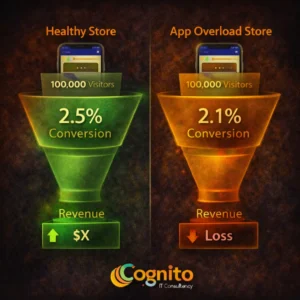
- You generate 100,000 visitors monthly
- Your baseline conversion rate is 2.5%
- App overload reduces it to 2.1%
That 0.4% drop could mean thousands in monthly lost revenue.
Over 12 months, that becomes significant.
And over three years, it becomes strategic damage.
Why App Overload Feels Productive But Isn’t
Installing apps feels proactive.
You add:
- A personalization engine
- A bundle builder
- A loyalty app
- A heatmap tool
- A review enhancer
Each promises growth.
Yet together, they often cannibalize performance.
The illusion of optimization hides the Conversion Cost of App Overload.
More tools do not equal better results.
Better architecture does.
The Psychological Impact of Overloaded Interfaces
Beyond speed, overloaded interfaces create decision fatigue.
When users see:
- Multiple offers
- Conflicting discounts
- Competing banners
They hesitate.
Clarity drives action.
Complexity drives exit.
Therefore, UX simplification often increases revenue more than adding features.
Performance Metrics That Reveal the Conversion Cost of App Overload
If you suspect app overload, review:
- Time to First Byte (TTFB)
- Largest Contentful Paint (LCP)
- Total Blocking Time (TBT)
- Checkout completion rate
Additionally, compare performance before and after installing major apps.
Often, the timeline tells the story.
Revenue slows gradually.
Not suddenly.
How to Reduce the Conversion Cost of App Overload
Eliminating app overload does not mean removing all apps.
Instead, it means auditing strategically.
1️⃣ Audit Monthly App Costs and Scripts
Identify which apps inject front-end scripts. Remove redundancies.
2️⃣ Consolidate Overlapping Features
If three apps provide similar functions, choose one.
3️⃣ Consider Custom Development
Custom Shopify apps centralize functionality. They reduce script stacking and improve performance.
Over time, this improves both speed and margin.
4️⃣ Prioritize Core Experience
Load product content first. Marketing elements should follow.
Performance-first design protects conversions.
Why This Is Not About Technical Debt
Technical debt refers to messy code and long-term maintenance issues.
The Conversion Cost of App Overload is different.
It is customer-facing friction.
It affects:
- Perceived brand quality
- Checkout confidence
- Shopping momentum
This is not an internal problem.
It is a revenue problem.
Founders Must Think in Conversion Efficiency
Growth is not only about acquiring more traffic.
It is about converting existing traffic better.
When app overload reduces conversion by even 0.3%, marketing budgets must increase to compensate.
That increases acquisition cost.
And acquisition cost eats margin.
Therefore, performance optimization becomes a profit strategy.
A Consulting Perspective: Architecture Over Add-Ons
At Cognito IT Consultancy, we approach scaling differently.
Instead of stacking apps, we:
- Audit performance impact
- Calculate revenue loss from slowdown
- Consolidate overlapping tools
- Build custom solutions where needed
This architecture-first mindset protects long-term growth.
Because sustainable performance beats temporary feature boosts.
FAQs: Conversion Cost of App Overload
1️⃣ What is the Conversion Cost of App Overload?
It is the revenue lost due to performance slowdown and UX clutter caused by excessive Shopify apps.
2️⃣ How many apps are too many?
There is no fixed number. However, stores with 15+ apps often experience measurable performance decline.
3️⃣ Does removing apps always increase conversion?
Not always. Strategic consolidation works better than mass removal.
4️⃣ How can I measure performance impact?
Use tools like Google PageSpeed Insights and compare metrics over time.
5️⃣ Is custom development expensive?
Upfront, yes. Long-term, it often reduces costs and improves conversion rates.
6️⃣ Why does UX clutter reduce revenue?
Because decision fatigue increases hesitation and abandonment.
Conclusion: Less Can Convert More
The Conversion Cost of App Overload does not appear on your balance sheet.
But it appears in your bounce rate.
It appears in your checkout abandonment.
It appears in slower growth despite higher traffic.
Sometimes growth does not require adding another tool.
Sometimes it requires removing three.
At Cognito IT Consultancy, we help brands simplify architecture, improve performance, and protect conversion efficiency.
Because in eCommerce, speed and clarity win.
And overload loses.
📩 Get your free audit here: https://cognitoitconsultancy.com/
📧 Book a Strategy Call: info@cognitoitconsultancy.com
👉 Meet Now: https://cal.com/cognitoitconsultancy/30min
🔗 Shopify Experts: Click Here
Follow Us for More Insights on D2C and Digital Transformation
Stay ahead of the curve in e-commerce, digital strategy, and IT consulting by connecting with us on our social platforms:


