
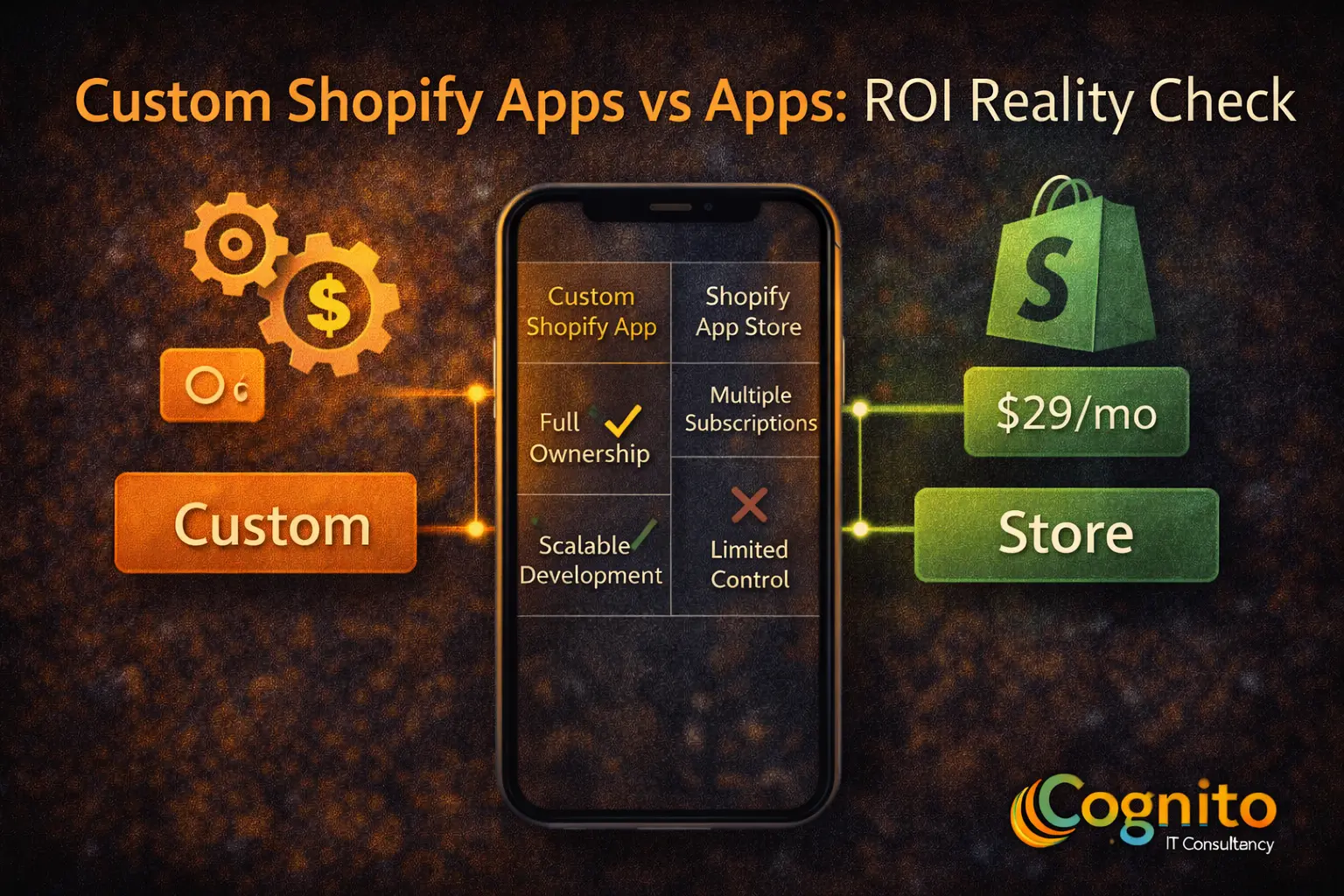
Custom Shopify Apps vs Apps: A Cost Reality Check
Custom Shopify Apps vs Apps: At first glance, Shopify App Store solutions look cheap.
$19 per month.
$49 per month.
Maybe $99.
However, when you zoom out, the debate around Custom Shopify Apps vs Apps from the Store becomes less about monthly fees — and more about long-term ROI.
At Cognito IT Consultancy, we often meet founders who stack 12 to 18 apps. Each one solves a small problem. Together, they create hidden complexity.
So the real question is not:
“Which option is cheaper today?”
Instead, it is:
“Which option delivers sustainable ROI over three years?”
Understanding Custom Shopify Apps vs Apps from the Store
When comparing Custom Shopify Apps vs Apps, you must evaluate control, scalability, and operational efficiency.
Shopify App Store solutions offer:
- Quick installation
- Pre-built functionality
- Low upfront cost
Custom Shopify apps offer:
- Tailored functionality
- Full ownership
- Integration flexibility
- Long-term cost control
Both serve different business stages. However, growth changes the equation.
The Hidden Costs in Custom Shopify Apps vs Apps
Most merchants underestimate the real cost of stacking third-party apps.
Here’s what typically happens:
You install a review app.
Then an upsell app.
Then a subscription app.
Then a loyalty app.
Then a reporting tool.
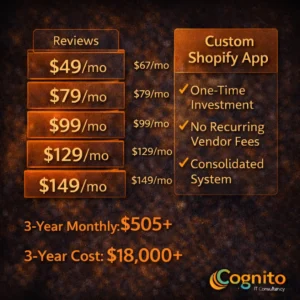
Suddenly, you pay:
- $600 to $2,000 per month
- Extra API call fees
- Increased theme load time
- Integration conflicts
In contrast, custom development centralizes functionality.
Instead of paying 10 vendors, you invest once in scalable architecture.
Over 24–36 months, that difference compounds significantly.
Performance Impact: Custom Shopify Apps vs Apps
Speed equals revenue.
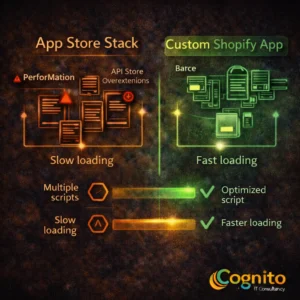
Every additional app injects scripts, APIs, and tracking pixels. As a result, your site slows down.
A one-second delay can reduce conversion rates meaningfully.
Custom Shopify apps eliminate redundant scripts. They integrate natively with your theme and backend.
Therefore, performance improves.
And improved performance drives higher revenue per visitor.
Scalability and Custom Shopify Apps vs Apps
In early stages, off-the-shelf apps work well.
However, as operations grow, limitations appear.
For example:
- You need custom reporting logic.
- You want unique discount rules.
- You require ERP integration.
- You need multi-region pricing automation.
Most Shopify apps solve general use cases. They rarely adapt to complex workflows.
Custom Shopify apps evolve with your business model.
That flexibility protects long-term ROI.
Security and Data Ownership
Another overlooked factor in the Custom Shopify Apps vs Apps debate is data control.
When using third-party apps:
- Customer data flows through external systems.
- API reliability depends on vendors.
- App shutdown risk exists.
With custom apps:
- You control data pipelines.
- You reduce external dependencies.
- You protect sensitive information.
For scaling brands, this matters more each year.
Long-Term ROI: Custom Shopify Apps vs Apps Comparison
Let’s compare a three-year scenario.
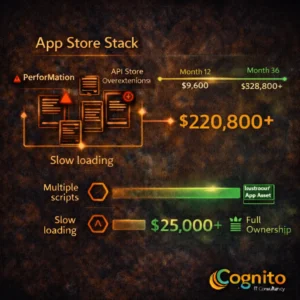
| Category | App Store Stack | Custom Shopify App |
|---|---|---|
| Monthly Cost | $1,200 average | $0 recurring vendor fees |
| 3-Year Cost | ~$43,000 | $25,000–$40,000 one-time |
| Performance Impact | Slower | Optimized |
| Flexibility | Limited | High |
| Vendor Risk | High | None |
While custom development requires upfront investment, it removes recurring subscription inflation.
Moreover, it reduces operational friction.
And friction costs time.
Time costs money.
When App Store Solutions Make Sense
To be fair, Shopify App Store solutions are powerful tools.
They work well when:
- You are validating product-market fit.
- The budget is limited.
- Requirements are simple.
- Speed matters more than optimization.
However, as revenue grows beyond mid-six figures, the math shifts.
That’s when Custom Shopify Apps vs Apps becomes a strategic decision.
When Custom Development Wins
Custom Shopify apps make sense when:
- Monthly app costs exceed $1,000
- Integrations create performance bottlenecks
- You need unique customer journeys
- You require automation beyond generic features
- You plan for 3+ years of scale
In these scenarios, custom development is not a luxury.
It is infrastructure.
The Operational Efficiency Factor
Most founders overlook operational drag.
Every additional app means:
- More dashboards
- More billing cycles
- More support tickets
- More compatibility updates
Custom development centralizes systems.
As a result, teams spend less time managing tools — and more time driving growth.
That operational clarity directly increases ROI.
Consulting Insight: The Hybrid Strategy
At Cognito IT Consultancy, we rarely recommend extremes.
Instead, we design hybrid strategies:
Phase 1: App Store validation
Phase 2: Custom consolidation
Phase 3: Infrastructure optimization
This approach balances agility with long-term cost control.
Because in the Custom Shopify Apps vs Apps debate, timing matters.
Common Misconceptions About Custom Development
Let’s clear a few myths.
Myth 1: Custom apps are only for enterprise brands.
Reality: Mid-sized brands benefit most from consolidation.
Myth 2: Custom apps take years to build.
Reality: Most targeted builds complete within 8–16 weeks.
Myth 3: App Store apps are always cheaper.
Reality: Subscription stacking erodes margin quietly.
When founders calculate the total cost of ownership, the picture changes.
Future-Proofing Your Shopify Architecture
E-commerce is becoming more AI-driven and API-focused.
If your store depends heavily on fragmented third-party apps, adaptability decreases.
Custom Shopify apps position your backend for:
- AI integration
- Headless commerce
- Advanced analytics
- Automation scaling
Future-proofing reduces re-platforming risk.
And that protects capital.
FAQs: Custom Shopify Apps vs Apps
1️⃣ Are Custom Shopify Apps vs Apps always more expensive?
Upfront, yes. Long-term, often no.
2️⃣ When should I switch to custom development?
When monthly app costs and operational friction begin to limit growth.
3️⃣ Do custom apps improve performance?
Yes. They reduce redundant scripts and external API dependencies.
4️⃣ Can small brands benefit?
Yes, especially when scaling toward seven figures.
5️⃣ How long does custom development take?
Typically 8–16 weeks, depending on complexity.
6️⃣ What does Cognito IT Consultancy provide?
We audit your current stack, calculate ROI impact, and design scalable custom solutions.
Conclusion: Think Beyond Monthly Fees
The debate around Custom Shopify Apps vs Apps should not focus on $29 subscriptions.
It should focus on:
- Three-year ROI
- Operational efficiency
- Performance optimization
- Scalability
Short-term savings often create long-term cost.
Meanwhile, strategic custom development builds durable infrastructure.
At Cognito IT Consultancy, we help founders calculate real cost — not just visible cost.
Because sustainable growth depends on architectural decisions, not app count.
📩 Get your free audit here: https://cognitoitconsultancy.com/
📧 Book a Strategy Call: info@cognitoitconsultancy.com
👉 Meet Now: https://cal.com/cognitoitconsultancy/30min
🔗 Shopify Experts: Click Here
Follow Us for More Insights on D2C and Digital Transformation
Stay ahead of the curve in e-commerce, digital strategy, and IT consulting by connecting with us on our social platforms:


