

From ERP to POS: Building Unified Commerce on Shopify Plus
🏬 From ERP to POS: Building a Truly Unified Commerce Strategy on Shopify Plus
For high-revenue brands, Shopify Plus offers more than just scalability — it offers flexibility. But when your business operates across multiple channels, warehouses, and systems, even the best eCommerce platform can’t function in isolation.
That’s where a unified commerce strategy becomes essential — one that connects your ERP, CRM, POS, and WMS systems seamlessly with Shopify Plus.
This isn’t just about integration. It’s about creating a single source of truth that drives better decisions, smoother operations, and a frictionless omnichannel experience.
⚙️ What Is Unified Commerce — and Why It Matters
Unified commerce goes beyond multichannel or omnichannel strategies.
It’s not just about selling in multiple places; it’s about ensuring every channel shares the same data in real time.
When ERP (Enterprise Resource Planning), CRM (Customer Relationship Management), and POS (Point of Sale) systems talk to your Shopify Plus store seamlessly, you achieve:
Accurate, real-time inventory across online and offline channels
Consistent customer experience at every touchpoint
Streamlined operations from warehouse to checkout
Smarter decision-making through centralized reporting
In short, unified commerce = connected business intelligence.
💡 The Challenges of Integration for High-Revenue Brands
While the concept sounds simple, Shopify ERP integration is complex — especially for enterprises managing thousands of SKUs, multi-location warehouses, and global audiences.
1️⃣ Fragmented Data Silos
When data sits separately in ERP, CRM, and Shopify, it leads to sync delays, overselling, and fulfillment errors.
2️⃣ Manual Inventory Updates
Without automation, teams spend hours reconciling data between systems — increasing the risk of inaccuracies and delayed reporting.
3️⃣ Inconsistent Customer Experiences
Disconnected systems can’t provide real-time visibility into order status, loyalty points, or stock availability — leading to broken omnichannel experiences.
4️⃣ Custom API Complexities
Large enterprises often rely on custom ERP solutions that require tailored integration frameworks — not out-of-the-box connectors.
The result? Lost productivity, inconsistent data, and a customer journey that feels fragmented.
🔗 Why Shopify Plus Is Built for Unified Commerce
Shopify Plus provides enterprise-grade flexibility to connect your core business systems through APIs, webhooks, and middleware.
It’s not a closed ecosystem — it’s a foundation for unified commerce.
Real-Time API Connectivity
Shopify Plus APIs (Admin, Storefront, and GraphQL) allow you to push and pull data between systems in real time — keeping inventory, pricing, and customer data always current.
Multi-Location Inventory Support
With Shopify Locations, brands can sync inventory from multiple warehouses and retail stores into one unified dashboard.
Seamless POS Integration
The Shopify POS Pro system bridges online and offline sales — allowing customers to buy online and pick up in-store (BOPIS) while ensuring unified stock management.
Scalable for Enterprise Systems
Whether you use SAP, NetSuite, Microsoft Dynamics, Zoho, or Oracle ERP, Shopify Plus supports robust middleware integration for smooth data flow.
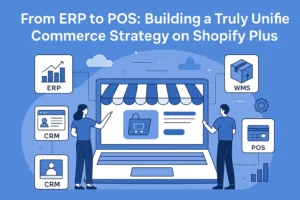
🧩 Key Integrations That Power Unified Commerce
To achieve end-to-end visibility, the following integrations are critical for any Shopify Plus omnichannel strategy.
ERP Integration (Enterprise Resource Planning)
The ERP is your operational backbone. Integrating it with Shopify ensures:
Real-time stock updates
Automated purchase orders
Synchronized financial data
Centralized product management
Common Shopify ERP integration examples include:
Shopify + SAP
Shopify + Oracle NetSuite
Shopify + Microsoft Dynamics 365
Shopify + Zoho ERP
CRM Integration (Customer Relationship Management)
CRM integration bridges marketing and sales, providing a single view of customer behavior.
Syncing Shopify Plus with CRMs like HubSpot, Salesforce, or Zoho CRM allows:
Personalized campaigns
Unified customer profiles
Seamless loyalty program management
WMS Integration (Warehouse Management System)
A WMS integration eliminates inventory discrepancies and improves fulfillment speed.
When connected to Shopify Plus, it automates stock movements, order picking, and tracking in real time.
POS Integration (Point of Sale)
Shopify POS Implementation connects retail and online operations.
It synchronizes stock levels, pricing, and promotions — ensuring that in-store and online data are always in sync.
🧠 The Role of an IT Consultant in Unified Commerce
For most enterprise brands, the difference between integration and true unification lies in the strategy — and that’s where IT consultants play a crucial role.
Designing Robust Data Flow Pipelines
A skilled consultant builds middleware pipelines that ensure seamless bi-directional communication between Shopify and ERP/CRM/WMS systems.
These pipelines handle:
Real-time inventory sync
Order and fulfillment data exchange
Pricing and tax consistency
Centralized customer data consolidation
Preventing Data Conflicts and Sync Delays
With real-time syncing and automated error-handling systems, IT consultants eliminate inventory mismatches and overselling issues.
Supporting Omnichannel Scalability
Consultants ensure that integrations are scalable — capable of supporting new locations, currencies, and business models as the brand grows.
🔍 Real-World Example: Shopify ERP Integration Success
Imagine a global fashion brand operating both online and through 50 retail outlets.
Before integration, the brand faced:
Inventory mismatches between POS and Shopify
Delayed fulfillment updates in the ERP
Poor visibility into online/offline sales performance
After implementing a Shopify Plus unified commerce solution, powered by custom ERP + POS integration:
Real-time data synced across systems
In-store staff accessed live online stock
Customers enjoyed consistent pricing and faster fulfillment
The brand reduced operational costs by 25%
📈 The Business Impact of a Unified Commerce Strategy
When Shopify Plus is integrated with ERP, CRM, and POS systems, brands gain measurable advantages:
| Metric | Before Integration | After Unified Commerce |
|---|---|---|
| Inventory accuracy | 70% | 99% |
| Order processing speed | Manual (slow) | Real-time |
| Customer satisfaction | Inconsistent | Seamless |
| Operational cost | High | Reduced by 20–30% |
| Data visibility | Fragmented | Centralized & actionable |
🧭 How to Build a Unified Commerce Strategy on Shopify Plus
Creating a connected commerce ecosystem requires planning, technical expertise, and clear execution.
Step 1 — Conduct a System Audit
Identify all platforms — ERP, CRM, WMS, POS — and map how data currently flows between them.
Step 2 — Define Data Hierarchies
Determine which system holds the “master data” for each entity (product, customer, order).
Step 3 — Choose the Right Integration Method
Options include APIs, webhooks, middleware platforms (like Celigo, MuleSoft, or Patchworks), or custom-built connectors.
Step 4 — Implement Real-Time Sync Logic
Ensure your integrations support two-way, event-driven synchronization to avoid data lag.
Step 5 — Test and Monitor
Run end-to-end tests and set up continuous monitoring to catch sync issues before they affect operations.
🔧 Tools and Middleware for Shopify Integration
Modern middleware tools simplify the complexity of unifying data across multiple systems.
Some of the most effective ones include:
Celigo – For ERP & CRM integration
Patchworks – Ideal for retail & WMS systems
MuleSoft – Enterprise-grade API management
Zapier / Make – For lightweight automation and data triggers
Choosing the right middleware depends on your volume, architecture, and customization needs.
🧩 Key Takeaways
Unified Commerce ensures every system — ERP, CRM, POS, and WMS — operates on synchronized data.
Shopify ERP Integration eliminates inventory errors and manual updates.
Omnichannel Strategy requires seamless customer data flow between all channels.
Data Sync Consulting helps design reliable, real-time integration pipelines.
Shopify POS Implementation connects retail and e-commerce for a consistent shopping experience.
🚀 Conclusion: Powering the Future of Unified Commerce
In 2025 and beyond, Shopify Plus isn’t just an eCommerce platform — it’s the foundation of unified commerce for high-revenue brands.
By integrating ERP, CRM, POS, and WMS systems, brands gain a connected ecosystem that enhances efficiency, accuracy, and customer satisfaction.
Partnering with an experienced Shopify IT consultant ensures your systems communicate flawlessly — enabling real-time insights, faster fulfillment, and a truly seamless omnichannel experience.
📧 Contact: sandy@cognitoitconsultancy.com
🌐 Website: https://cognitoitconsultancy.com
👉 Build your unified Shopify Plus commerce strategy today. – Click Here
Follow Us for More Insights on D2C and Digital Transformation
Stay ahead of the curve in e-commerce, digital strategy, and IT consulting by connecting with us on our social platforms: