
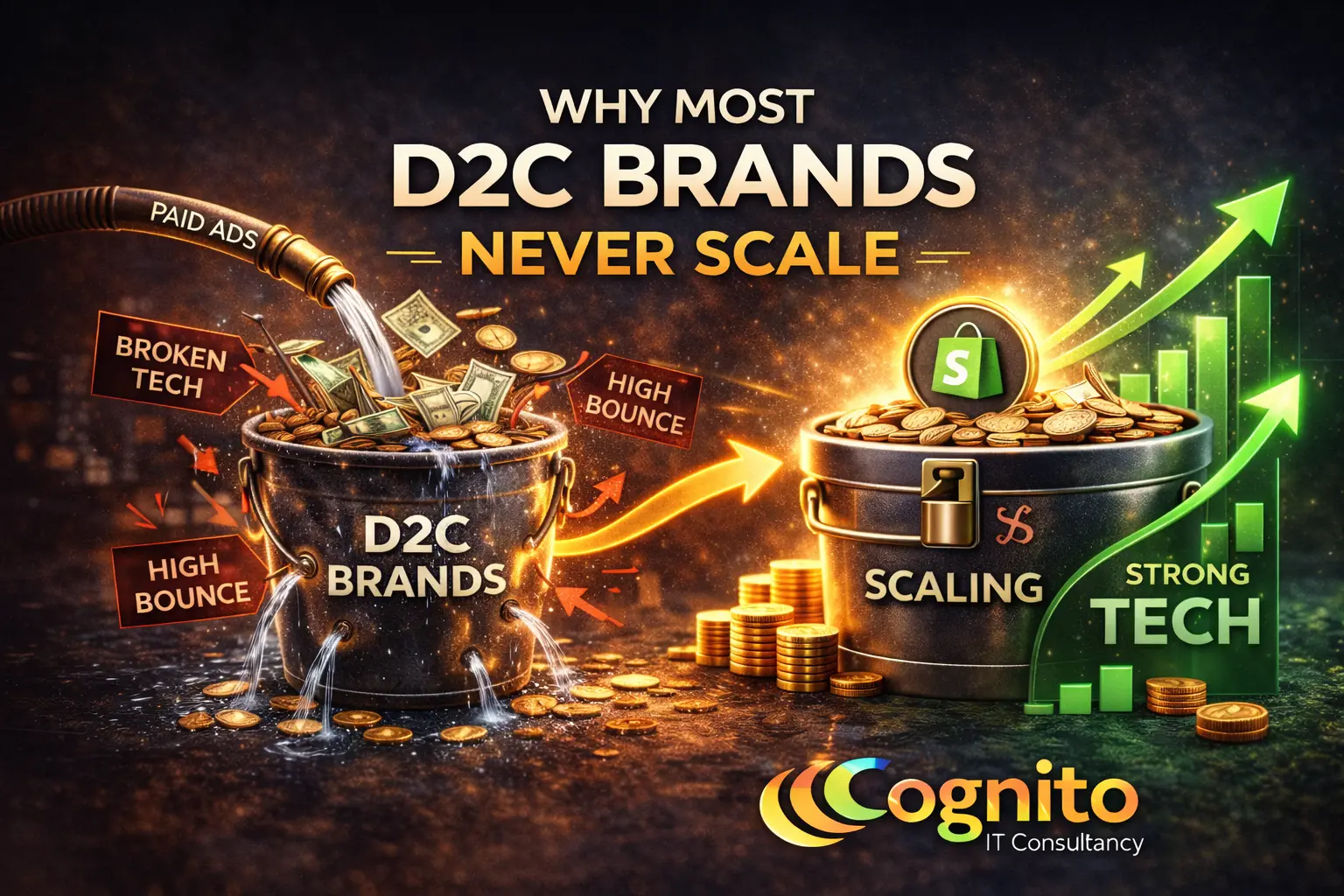
Why Most D2C Brands Never Scale
India is full of ambitious founders. Every month, new Shopify stores launch. New ads go live. New brands promise disruption. Yet very few achieve sustainable D2C brand scaling.
Most brands hit ₹1 crore and stall.
The reason?
It is not the product.
It is not the logo.
It is not even the ads.
It is infrastructure.
If you want serious D2C brand scaling, you must fix what sits behind the storefront.
Let’s break it down.
The Real State of D2C Brand Scaling in India
India’s D2C market is booming.
Low entry barriers.
Easy Shopify setup.
Accessible performance marketing.
However, opportunity does not guarantee scale.
Customer acquisition costs are rising.
Competition is fierce.
Margins are shrinking.
Therefore, D2C brand scaling now requires operational maturity.
Brands that scale build systems.
Brands that stall chase tactics.
That difference changes everything.

D2C Brand Scaling Mistake #1: Weak Technical Infrastructure
Many brands build fast.
They install apps without audits.
They customize themes randomly.
They stack scripts endlessly.
Initially, it works.
But once traffic increases, cracks appear:
- Slow page load
- Checkout glitches
- Tracking errors
- App conflicts
Growth magnifies flaws.
True D2C brand scaling requires:
- Clean theme architecture
- Lean app ecosystem
- Structured product data
- Server-side tracking
Without technical stability, scale collapses.
D2C Brand Scaling and Mobile-First Execution
India is mobile-first.
Over 80% of traffic comes from smartphones.
Yet many stores feel desktop-built.
Buttons are small.
Text feels crowded.
Navigation confuses users.
Small friction reduces trust.
Reduced trust lowers conversion.
Lower conversion increases ad costs.
Therefore, D2C brand scaling depends on:
- Clear above-the-fold messaging
- Thumb-friendly layout
- Fast mobile checkout
- Visible trust badges
- Simple variant selection
Mobile UX is not cosmetic.
It is financial.
D2C Brand Scaling Mistake #2: No Retention Strategy
Acquisition is exciting.
Retention is profitable.
However, many brands stop at basic email flows.
No segmentation.
No behavioral triggers.
No personalization.
That limits lifetime value.
Limited LTV blocks D2C brand scaling.
Smart brands automate:
- Welcome journeys
- Abandoned cart sequences
- Replenishment reminders
- Cross-sell flows
- Loyalty campaigns
Automation builds recurring revenue.
Recurring revenue stabilizes scale.
D2C Brand Scaling Requires Early CRO Investment
Most founders delay optimization.
They push ads first.
They test creatives daily.
But ignore store performance.
That order is dangerous.
Conversion rate is the multiplier.
If your store converts at 1.5%, scaling ads scales waste.
If it converts at 3%, scaling ads compounds profit.
Therefore, real D2C brand scaling demands early CRO.
Optimize:
- Headlines
- Product positioning
- Trust elements
- Pricing psychology
- Checkout flow
CRO is revenue science.
Why D2C Brand Scaling Fails at ₹1 Crore
₹1 crore feels like momentum.
However, complexity increases at that stage.
More SKUs.
More campaigns.
More returns.
More customer queries.
If systems are weak, operations break.
Cash flow tightens.
Margins shrink.
Growth slows.
Many brands respond by increasing ad spend.
That worsens the problem.
Instead, pause and strengthen infrastructure.
That is how D2C brand scaling moves beyond early revenue milestones.
D2C Brand Scaling and Unit Economics Discipline
Scaling brands understand numbers deeply.
They track:
- Contribution margin
- Break-even ROAS
- CAC by channel
- LTV by segment
They do not scale blindly.
They scale with clarity.
Without economic discipline, even strong revenue feels fragile.
True D2C brand scaling requires margin awareness.
Revenue alone does not equal growth.
Profit sustains scale.
D2C Brand Scaling: Website as a Sales Engine
Many founders treat their website as a brochure.
Nice photos.
Basic copy.
Minimal persuasion.
That approach limits performance.
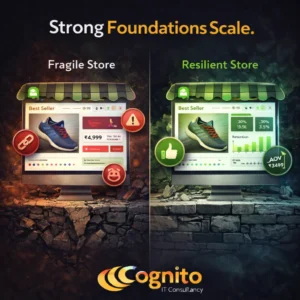
A scaling store must:
- Remove objections instantly
- Highlight social proof
- Simplify decisions
- Encourage upsells
- Guide behavior clearly
Every section must serve a purpose.
Every page must move users forward.
This mindset shift fuels D2C brand scaling.
What Actually Drives Sustainable D2C Brand Scaling
Let’s simplify it.
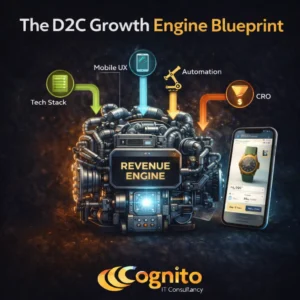
Sustainable scale rests on five pillars:
- Clean Technical Infrastructure
- Mobile-First UX
- Structured Automation
- Early CRO Investment
- Accurate Data Tracking
Remove one pillar, and growth slows.
Strengthen all five and scale compounds.
This is not a theory.
It is an operational reality.
D2C Brand Scaling Is About Systems, Not Hacks
Growth hacks create spikes.
Systems create stability.
Ad creatives change weekly.
Infrastructure decisions last years.
Founders serious about D2C brand scaling invest in:
- Backend stability
- UX clarity
- Automation maturity
- Data hygiene
They do not rely solely on paid media.
They build engines.
How Cognito IT Enables D2C Brand Scaling
At Cognito IT Consultancy, we focus on structure first.
We help founders:
- Audit technical stack
- Optimize mobile performance
- Implement scalable automation
- Improve conversion rates
- Strengthen analytics setup
We turn Shopify stores into performance systems.
Because ads amplify what already exists.
If your system is strong, scale accelerates.
If your system is weak, the scale collapses.
Book a Free D2C Growth Strategy Call
If your brand feels stuck around ₹1 crore, do not increase ad spend blindly.
Instead, strengthen your foundation.
Book a Free D2C Growth Strategy Call
👉 Book a Free D2C Growth Strategy Call: https://cognitoitconsultancy.com/
📧 Book a Strategy Call: info@cognitoitconsultancy.com
👉 Meet Now: https://cal.com/cognitoitconsultancy/30min
🔗 Shopify Experts: Click Here
Follow Us for More Insights on D2C and Digital Transformation
Stay ahead of the curve in e-commerce, digital strategy, and IT consulting by connecting with us on our social platforms:


Let’s build a system that supports serious D2C brand scaling.
Final Thoughts
India’s D2C opportunity is massive.
However, the opportunity rewards structure.
If you want real D2C brand scaling, focus on:
Infrastructure.
Mobile UX.
Automation.
Conversion rate.
Data clarity.
Scale is not noise.
Scale is architecture.
And the brands that understand this will move beyond ₹1 crore — sustainably.